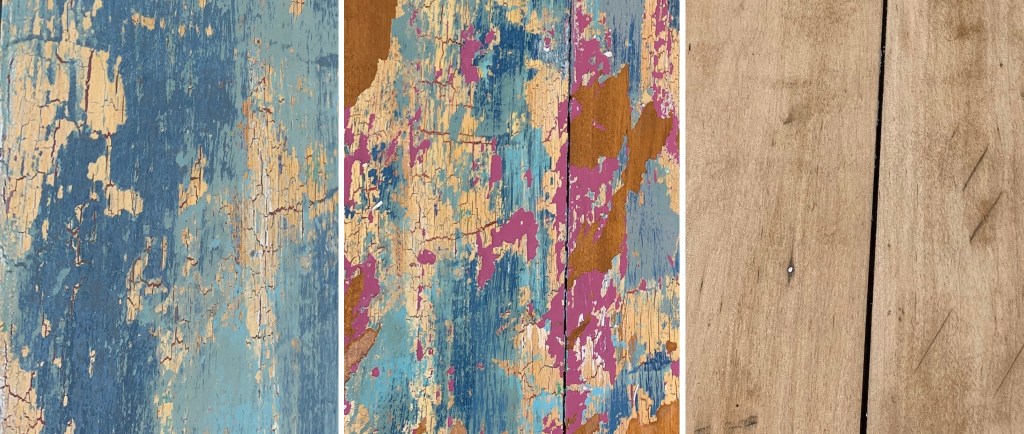
I don’t even remember where I bought this old table—that’s how old it is. Probably a Labor Day flea market, but I couldn’t swear to it. For over 20 years, this table has worked its way through various rooms in my house, serving as a microwave or TV stand, a desk, a vanity, and finally, a porch table. I bought it after I salvaged a small farmhouse table from the basement of a tenant house we lived in during the early 90s. The farmhouse table was my first attempt at refinishing, and I fell in love with the process and the table. Looking back, I probably bought this little table (or maybe vanity?) because it was a smaller version of my prized possession.
Anyway.
I decided to fix up this little table and move it from the neglected porch to my much-used craft room. On the first stay-home-all-day day of summer break, I tackled the table. Initially, I thought I could sand the existing paint smooth enough to . . . paint the table (again). It didn’t take much sanding and inspecting to realize I wouldn’t be happy with the end result. I pressure-washed the grime from the table and began a days-long restoration project.
I entered this restoration project without a definite plan. I hadn’t really considered staining the table; as far as I knew, the wood was ugly—nothing I cared to highlight. Even as I stripped away layer after layer of paint—everything from country rose to a crackle finish to stencil flowers and freehand peace signs to a few layers of chalk paint—I imagined the soft grey, aqua, and linen hues I’d apply. As I sanded away the last traces of the evolution of crafty painting attempts, I visualized the smoky glaze I’d use to add dimension.
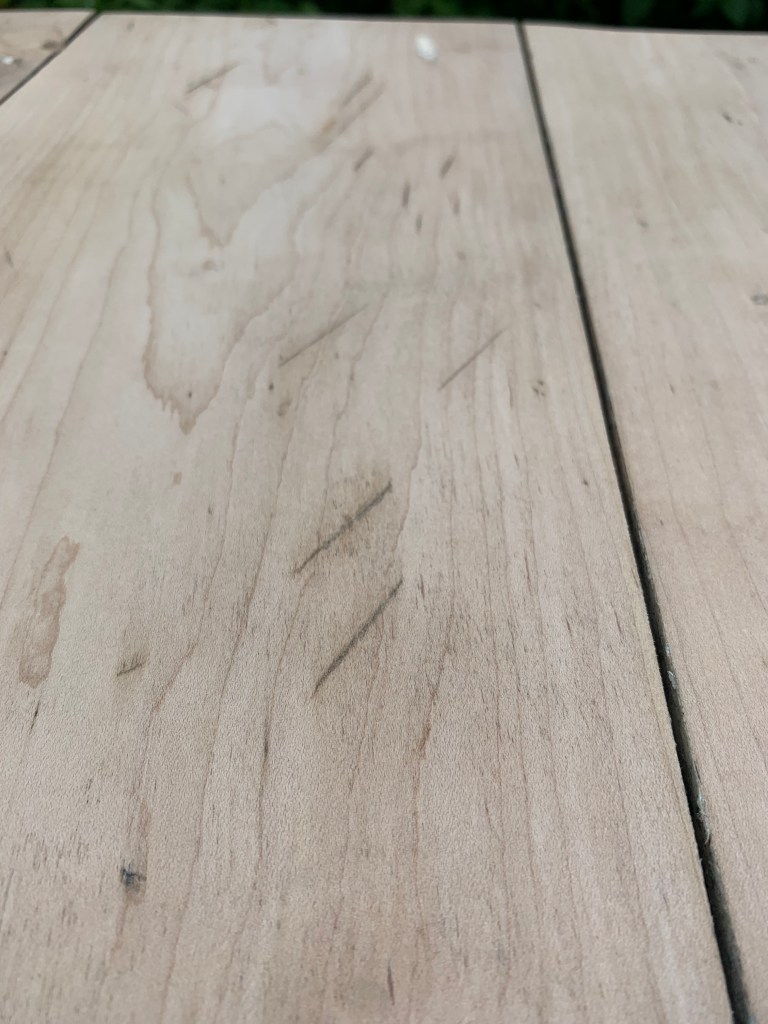
Then I looked at what my hands (and sander and Dremel tool) had uncovered. The open grain, the cuts and gouges, the holes along the back edge. This table has a story to tell.
Decisions.
Should I glue the dowels? The table top is comprised of three boards (of three different widths). One board detaches completely if I pull; the other two separate, but not completely. I thought about this decision for three days. I wanted to do a good job with this project, but as I studied the table and its intricacies, I also wanted to honor the table’s story. No glue. If the table falls apart, I’ll put it back together. Falling apart isn’t all bad.
How far to go with the sanding? I have the time and the sandpaper. I have sanders galore. I could work until the surface was perfectly smooth and unmarred, but why? The table earned those scars. Brandi Carlile’s “The Story” begins with “All of these lines across my face/tell you the story of who I am/so many stories of where I’ve been/and how I got to where I am.” I sanded until the clear areas were smooth. The scars and lines and gouges stay; they are the table’s storytellers.
What about stubborn paint? Even after all the stripping and sanding, there were patches of pesky paint clinging to the underside of the table top. Yes, I want to do a good job, but reminders of the past are okay. The paint existed. It happened. Some paint remains, but it doesn’t show unless you crawl under the table and inspect the crevices. Frankly, if you look that closely, you should be prepared to deal with stubborn, story-telling paint.
And then there’s the drawer. The drawer is rickety—so rickety that it must be original. Rickety and rough. The drawer’s innards show the age of the table, the determination of the builder, the focus on what shows versus what quietly serves a purpose. The drawer front is no longer smooth and true; one end sports a divot of several inches, large enough that the frame of the drawer is visible at the corner. Still, the drawer can do drawer things. It’ll be okay.
It was during the stripped, sanded, bare wood phase that I connected with the table. There’s beauty in its scars; I’ve come to respect scars. What should I do? Paint the table, cover its uniqueness, gloss over the unsightly bits? Clear-coat it, leaving every last mark and cut and dent exposed, constant reminders of ugliness? Did I work that hard only to hide what I’d discovered?
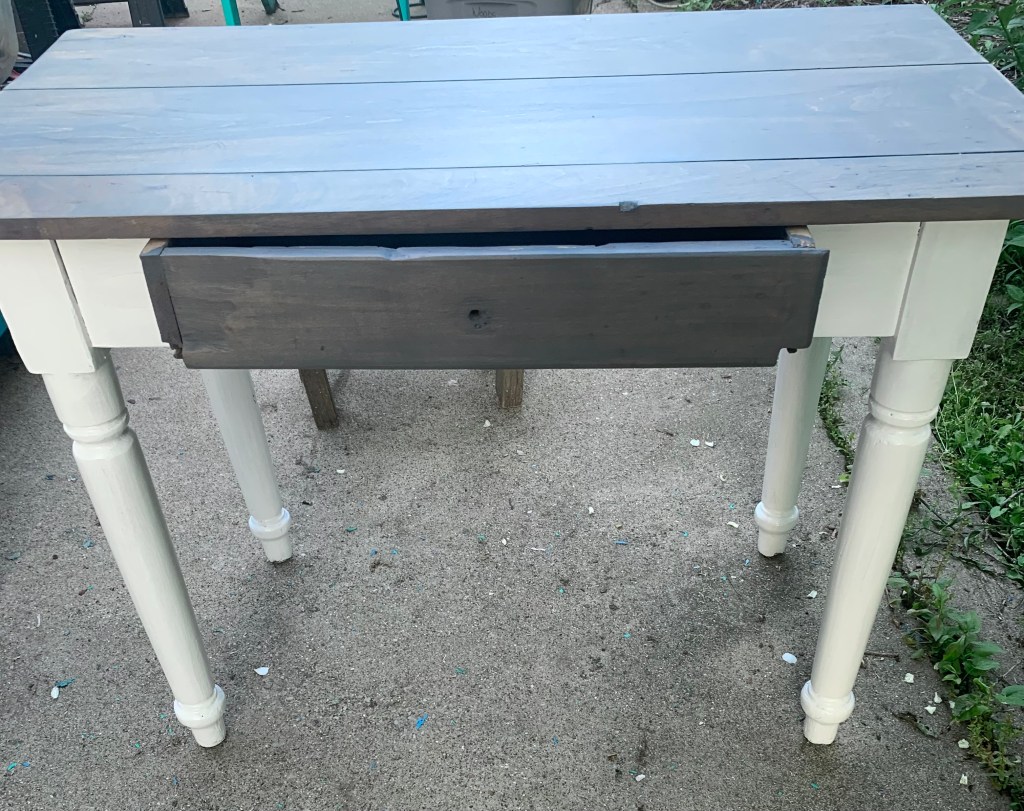
A compromise. Grey stain on the top and the drawer, white paint on the rest. The stain doesn’t hide the table’s story. The paint does, unless you know where to look for the damage brought by living. (Yes, the drawer closes. The paint was still tacky.)
The table sleeps in the craft room tonight. I will use it almost daily. Eventually, I’m sure I’ll add to the marks, the scars, the gouges, but I’d rather use this table and leave marks than relegate it to the porch or the basement.
It’s old. It’s had a rough life. It bears the scars of that life.
It’s still a table (or maybe vanity?). It still has purpose. Those scars tell you the story of where it’s been.
 Woods Writes
I love that song, and Your Story, Cooper’s Story are important. Can’t wait to see you at Bloom on June 17. I asked everyone to bring something they created.
LikeLike