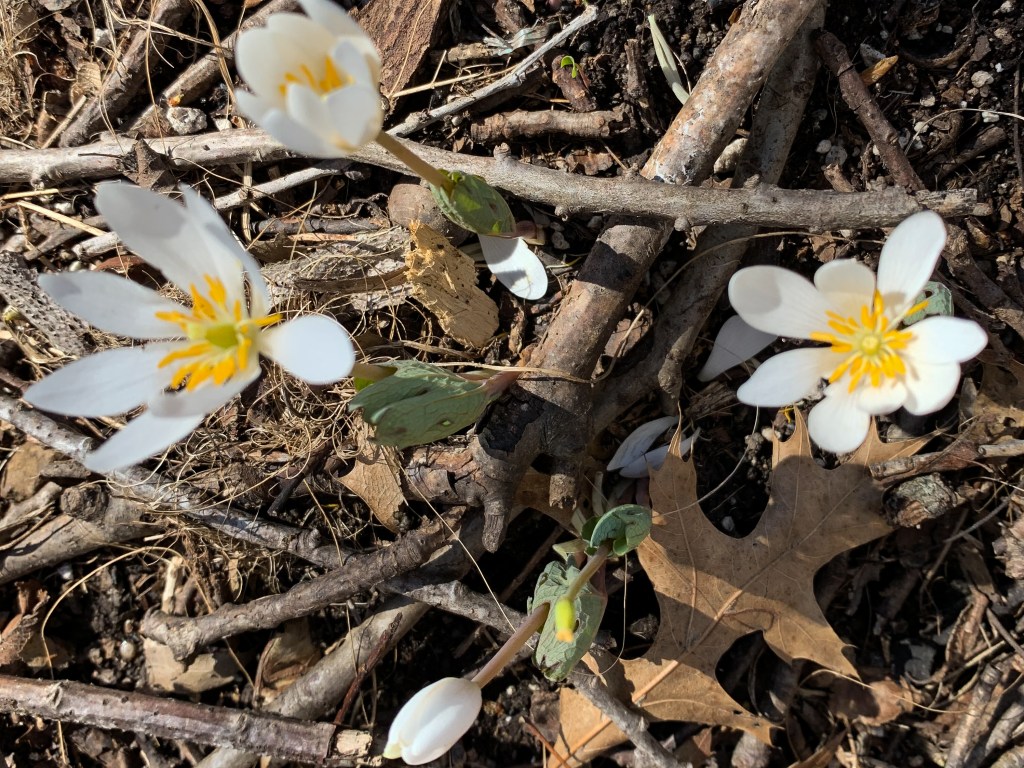
Consider this my annual homage to sanguinaria canadensis. Bloodroot. My absolute favorite of the wildflowers that grace my yard each spring. They are the first to bloom — a welcome sight as winter fades. They don’t mess around, either; they show up, bloom, hope for pollination, and drop their petals. My little loves have attitude.
How lucky am I that this happens in my yard, below my living room window, each spring?
See, unlike my mom, I’m no Master Gardener. I’m mostly a neglectful gardener, no caps. Imagine my delight, then, in these tiny beauties. They just show up, some sort of flower magic. I love them, but I don’t do anything to deserve their yearly appearance. Since they’ve survived 23 years of neglectful adoration, I feel comfortable saying in the grand scheme, they are tougher than they look. In the grand scheme.
Short term, they are precisely as fragile as they look. Bloodroot only bloom a few days. They close up each night and often don’t open at all on dark, cloudy days. It’s all about the pollination. Today, they put on a display, but it was a costly display; this windy March day left the ground littered with white petals. Days like today can end the bloom, pollination be damned.
Both tough and fragile, bloodroot are complicated treasures. The “bloom where you’re planted” phrase, taken literally, could be about bloodroot. They are not transplant fans. If you pluck one from its stem or pull it and break the root, you’ll find a runny red center. In the past, that sap has been used as dye and war paint. Also, they are poisonous. Complicated little treasures.
Bloodroot are so much more than the first wildflower of the spring. They are, in some ways, spring embodied — beautiful, wild, unpredictable. There have been years the blooms came early, surprising me. Thrilling and invigorating me. There have been single days that left me an entire bed of naked stems; a strong wind can ruin everything pretty about bloodroot, but it doesn’t kill them.
No, being stripped to the stem doesn’t equal death, although they may look like death. When bloodroot first emerge they are a tiny, clenched point of life. Soon, the stem pushes up and out, and the bloom appears. In the above photo, the flowers seem to stand alone in their beauty. Barely noticeable are their single, eventually-broad leaves wrapped tightly around the stem, waiting their turn. When the petals fall, either in their own time or because of a storm, the leaves unfurl and get to work. New seeds mature in their pod. The flowers are showy, but without this quiet, subtle part — the leaves and the seed pods — the plants won’t flourish next year.
Many of us are walking through life stripped to the stem these days, our petals littering the ground of our lives. We aren’t dead, but we may look dead, feel dead, act dead. Some of us lost our petals naturally, after pollination. Others of us are living in a storm, our petals blown loose prematurely. All of us stand bare to the world, awaiting the cover and protection — the shelter — of our leaves. When the leaves loosen their grip on our stems, open to the world, and grow, can we appreciate them? Can we allow them to do what leaves do? Will we even recognize the leaves?
And let’s not forget the poisonous part. We are complicated little treasures, after all.
 Woods Writes